

|
|
||||
Feature Articles: Alien Abductions, Cattle Mutilations, Conspiracies, Roswell, UFOsUniversity of Texas Features Roswell Photographs
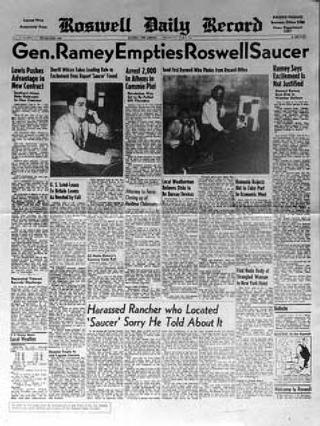
It has been announced by the University of Texas at Arlington that on June 1, 1998, a special exhibit will open in the Special Collections Section of the Main Library featuring super-enlargements of the more than half-century old famous Roswell UFO crash photographs. In making the announcement, Dr. Gerald D. Saxon, Associate Director for Special Collections, Branch Libraries and Programs, University Libraries, stated that the special exhibit will be offered in response to an unprecedented demand by the public to view at close range details of the newly enhanced photographs of the most famous and controversial UFO wreckage, which was "captured" by United States military forces near Roswell, New Mexico in 1947. Dr. Saxon stated that photographic exhibits at the library usually are scheduled at least two years in advance, but that this special photo exhibit has been arranged on very short notice due to world wide attention once again being focused on the UTA Library following a recent announcement that it has finally been established that the photos are of portions of the actual Roswell crash debris. Dr. Saxon said that due to a series of recent telephone calls being received at the library inquiring as to details of the library security system, that increased surveillance plans will be in effect. Visitors to the exhibit will not be permitted to bring into the library any purses or brief cases but that hand magnifying glasses will be allowed. The UFO research community was electrified this week by the surprise announcement that modern technology has debunked a longtime charge by some UFO writers of a blatant "cover-up" by Air Force Lt. General Roger M. Ramey in connection with the sensational Roswell Incident of 1947, which involved the announced "capture" of a crashed UFO. The results of a new digital scan applied to super-enlargements of the famous UFO photos taken by a reporter-photographer for the Fort Worth Star-Telegram show that the debris displayed in General Ramey's 8th Air Force Headquarters office in Fort Worth on July 8, 1947, is clearly consistent with eyewitness descriptions of the world's best-known "flying saucer" which had crashed near Roswell, New Mexico, a few days before and is not a "weather balloon" which had been substituted on orders of General Ramey. This includes clear identification of the "hieroglyphic-like" characters displayed along stick-like structures, including I-beams, and inclusion of very thin, but super strong metal-like material that resisted bending or crumpling. The resulting new discoveries discredit frequently repeated claims that General Ramey had concocted the "weather balloon" ruse and then had ordered the substitution of the "weather balloon" for the real wreckage, which had been flown secretly to Wright-Patterson Air Force base -- then known as Wright Field -- in Ohio for "further analysis" and where it reportedly has been kept under tight security for more than a half century. The newly obtained, digitally enhanced photographs reveal for the first time that "out of this world" qualities described by Major Jesse A. Marcel, Sr., Intelligence Officer stationed then at Roswell Army Air Base, who retrieved parts of the wreckage of the alleged alien-operated craft, are clearly established in the photos. The photographs were taken by Dr. J. Bond Johnson, who had been a reporter for the Star-Telegram since January of 1943. At the time of the Roswell Incident in 1947, Dr. Johnson had been discharged from the Army Air Corps after World War II service, which included training as an aircraft mechanic and pilot. He has practiced as a clinical psychologist and United Methodist minister for the past 35 years in Long Beach, California. He also is a retired US Army colonel. Upon arrival at General Ramey's office on July 8, 1947, Johnson unpacked portions of the wreckage from its paper wrappings and arranged the pieces for the photos while awaiting the arrival of General Ramey at his office. Johnson then took six shots with General Ramey, Colonel (later Brig. General) Thomas J. Dubose, Ramey's chief of staff, and Major (later Lt. Col.) Marcel, who had couriered the wreckage from Roswell to Ramey's headquarters in Fort Worth. Other packages of the wreckage, still unopened, also appear in the photos. Two of the negatives have disappeared from the files of the UTA Library but four original negatives remain and are safeguarded under heavy security. These four photographs will be featured in the special exhibition. The frequently quoted descriptions by Marcel, and repeated by Marcel's son, Dr. Jesse A. Marcel, Jr., an Army helicopter pilot and flight surgeon, who was shown some of the wreckage parts by his dad prior to their being turned over to the Roswell base commander, are further corroborated by civilian eye witnesses who were employees of the Brazell Ranch 85 miles northwest of Roswell, where the craft crashed, and some of their neighbors. The witnesses described the wreckage as including material that was "very lightweight, lead foil-like, very thin, metallic-like but not metal, and very tough." It also included very light "balsa-wood appearing sticks," including I-beams, some of which included "hieroglyphic-like" characters, possibly depicting some unknown writing. One witness described the "figures" as similar to the petroglyphs the ancient Native Americans etched on rocks in the Roswell area. Further, the witnesses described that some of the material, even though very thin, when crushed tended to "smooth-out" when released. There also was a quantity of black plastic looking material "which looked organic in nature that had either been melted or burned." Johnson also described the strong odor of burned debris when he was in the general's office with the wreckage. When questioned, Marcel -- who retired from the Air Force as a Lt. Colonel -- described the unusual markings on the sticks as "like Chinese writing....nothing you could make any sense out of." In his interviews Marcel stated that "they took a photo of me on the floor holding up some of the less-interesting metallic debris...pieces of the actual stuff we had found." Marcel said that the debris was scattered over a square mile of a ranch near Roswell. "It was something that must have exploded above ground and fell...it scattered all over." The new digitally enhanced, super-enlargements clearly show the strange metallic debris as described, including some thin metal-like parts, which are quite rigid and smooth, and the I-beams identical with the witnesses' descriptions. Marcel stated that the solid members were mostly square, "of varied lengths, and along the length of some of those they had little markings...two color markings as I can recall...like Chinese writing." His son described the markings as "flower-like" figures printed along the sticks. Yet for nearly 20 years UFO writers have claimed that the Air Corps engaged in a dramatic fraud to protect the UFO wreckage from Roswell and to mislead the press -- and the American public. The story concocted by the writers tell it generally this way: When Marcell turned the portions of the UFO wreckage he had recovered over to his base commander, Colonel William Blanchard. Blanchard then issued an official public announcement that the Air Corps had "captured" a flying saucer near Roswell and then notified his boss, General Ramey, of this dramatic event. The military had been widely searching for UFOs following sightings in many parts of the country during June and early July 1947. For some unknown reason, the writers decided that Ramey had concocted and executed a careful hoax. It was claimed that he sent the real UFO wreckage directly to Wright Field in Ohio for study and while the burning of a weather balloon and Rawin target. This fraudulent substitute was dispatched along with Major Marcel to 8th Air Force Headquarters in Fort Worth. There, the bogus material was displayed in Ramey's office and the Star-Telegram was invited to send out a reporter-photographer to cover the story. Johnson was selected and dispatched by his editor with camera in hand. When Ramey told Johnson that he didn't know what the unimpressive looking debris was, Johnson took his pictures and left. No other media representatives were allowed to view the debris or to take any pictures. All these exotic actions apparently were taken solely to mislead and misinform one 21-year-old photographer-reporter. Later that day, Ramey summoned a weather officer, Warrant Officer Irving Newton, to his office and instructed him to agree that the debris displayed was only a "weather balloon" and Newton was then photographed by a military photographer holding portions of this debris. Other Roswell writers have claimed that Marcel did accompany the actual debris to Fort Worth and was photographed by Johnson holding pieces of the wreckage. However, the actual debris was switched with the fake "weather balloon" before Ramey, Dubose and Newton were photographed. The new studies confirm that pieces of the wreckage seen in all the photos actually are identical. General Ramey then quickly went to a Fort Worth radio station and announced that his weather officer had decided that the Roswell crash was only a weather balloon with an attached radar target. Also, a news release was distributed to the press containing this false information. The press and the American public accepted the story based on the word of a distinguished war-hero general. There never has been any reason given as to why Ramey would have taken such a drastic and risky action to deceive the press and the public in this very dramatic way. Roswell UFO writers generally have continued to repeat the "balloon switch" fable. Nevertheless, Lt. Col. Marcel contended until his death in 1986 that the material he recovered and which he posed with in Ramey's office was "not part of any kind of weather balloon or experimental craft ... it was not made of anything available on earth." This description also has been corroborated by the civilian primary witnesses. Likewise, General Dubose was very clear when interviewed by UFO researcher Jaime Shandera shortly before the general's death. When asked to describe details of the photo session in General Ramey's office Dubose made the following statements: Shandera: J. Bond Johnson, reporter for the Fort Worth-StarTelegram, has stated that when he asked General Ramey what this debris was, Ramey said that he didn't know. You were present in that room at that time. Also, the Associated Press had carried a story indicating that General Ramey didn't know what the debris was when talking to (Air Corps Chief of Staff) General (Hoyt) Vandenberg in Washington." Dubose: "Well, that's true. None of us knew what it was." Shandera: "There are two researchers (Don Schmitt and Kevin Randle) who are presently saying that the debris in General Ramey's office had been switched and that you men had a weather balloon there." Dubose: "Oh Bull! That material was never switched." Shandera: "So what you're saying is that the material in General Ramey's office was the actual debris brought in from Roswell?" Dubose: "That's absolutely right." Shandera: "So not you or anyone else ever switched that material for the cover story." Dubose: "We never switched anything. We were under orders from Washington to look at that material. We wouldn't have switched anything. We were West Pointers -- we would never have done that." Shandera: "But General Ramey did put out a cover story that it was a weather device." Dubose: "Yes. We were ordered to get the press off our backs -- things were getting out of hand." Memories of witnesses may dim over the span of half a century and more. But West Pointer General Dubose remembered that day in July of 1947 very accurately it now appears. But digitally enhanced, super-enlarged photos taken by a 21-year-old reporter-photographer provide even a more convincing record. The debris of the Roswell crash photographed in General Ramey's office is indeed genuine. General Ramey, General Dubose and Lt. Colonel Marcel all were telling the truth about the Roswell Incident of 1947. Their reputations remain intact! And now the public also will be able to view the famous photos and speculate for themselves whether debris is from an extraterrestrial spacecraft or some earthly earth device. Now that it has been established what the Roswell wreckage is NOT -- maybe modern technology can help to solve the half-century old mystery of what the Roswell debris in fact IS! Meanwhile, from her home in Denton, Texas, Mrs. Latane Ramey, widow of General Ramey, issued through an official of the Air Force Association a statement that the family is very grateful that this new information has been released finally clearing General Ramey of any wrongdoing in handling the Roswell Incident. "We all want to keep him in high esteem. He was a wonderful man. Apparently everyone liked and respected him", Mrs. Ramey said. General Ramey was a native of Denton and attended North Texas State Teachers College before entering the US Military Academy, where he was graduated in 1928. During World War II he led the 58th Bomb Wing of the 20th Air Force, a B-29 unit, on several fire bomb raids over Japan. He later commanded a task force in the Army Air Corps during the Army-Navy participation in the 1946 atom bomb tests at Bikini Atoll in the Pacific. He was assigned to the Fort Worth Army Air Field in the spring of 1947 to reorganize the 8th Air Force, which had gained fame in leading the bombing of Germany during World War II. In 1949 he was honored by the Fort Worth Chamber of Commerce as "man of the year" for rescue work during the Trinity River flood that year. In 1950 he was named director of operations for the Air Force in Washington, DC, and promoted to three-star rank. After retirement from the Air Force, General Ramey served as vice president of Northrop Aircraft in Los Angeles. He was the father of a son, Kent, and daughter, Mary Latane, both of Denton. |
Alien Abduction Experience and Research
Copyright ©1996 - 2019. All Rights Reserved.
